The 2025 Book Awards

I don’t know if roaring is the word I would use for the last 6 years, but there has definitely been some screaming. AI is one step closer to becoming our global overlord; It can be difficult talking about frozen water in America without causing some confusion about immigration (and vice versa); Greenland and Canada are a little more frosty towards the U.S. (with good reason); And here, among the other things that always seem to be happening, are the 6th Annual Book Awards.

Awards

Best Fiction: Tress of the Emerald Sea by Brandon Sanderson
While Brando-Sando’s books haven’t historically made the same impression on me as they have on some of his more dedicated fans, I must give credit where it’s due and say he knocked it out of the park with this one. Inspired by The Princess Bride and written in a voice reminiscent of Discworld, it’s easily one of my favorite books. I loved the story and the setting; I loved the characters; I loved the humor; I really just had a great time and would very much recommend it. My singular gripe is that I wish the arc of one of the minor villains wrapped up in a more satisfying way. Otherwise, just fabulous. 10/10

Runner-up: The Will of the Many by James Islington
Another great book, though quite different from Tress. This was more reminiscent of the Red Rising series, with an underdog protagonist fighting against an oppressive regime of elites from the inside. There are kids vying for power and prestige in an island competition of wit and skill and cunning; there’s brutality and betrayal and triumphing against the odds; There’s intrigue and mystery surrounding ancient civilizations and technologies. It’s got it all, and it was very well done. The second book recently came out and it’s definitely on the reading list for this year. 9.5/10

Most Disappointing: I Heard There Was a Secret Chord by Daniel Levitin
With the book marketed as an exploration of the psychology and neuroscience of music and how it affects human health, I was jazzed to dive in. Unfortunately, Levitin was a little more concerned about how many names he could drop than about making a coherent, accurate, readable account. The narrative is all over the place, jumping from one anecdote to another with no warning, and with no regard for the title of the chapter. Many of the claims he makes are questionable at best, and some blatantly contradict earlier statements, really eroding his credibility. Among all the bragging there are some interesting tidbits, and he does do a good job of balancing scientific rigor with the emotional, magical feeling that music can produce. Overall, however, it just isn’t a good book, and I’ve avoided any others by him, no matter how enticing the titles. 4/10

Runner-up: Our Moon by Rebecca Boyle
I admittedly don’t know that much about the moon, physically, culturally, mythologically, historically, etc. And while Boyle seems to know quite a bit about the moon itself, it seems she doesn’t know as much as she thinks she does about things related to the moon. I found the beginning of the book very interesting, learning about the Metonic cycle, or how the moon has affected and does affect life. After the first few chapters, though, it went downhill. It started when she made claims about the moon and women’s menstrual cycles that are largely unsupported by science, continued through a number of historically inaccurate statements and gross mis-quotes or misattributions, and ended with a clear bias against religion and the Medieval period. 5/10

Nerdiest: Love Triangle by Matt Parker
Contrary to what the title suggests, this book is not about an over-dramatic teenage girl who has to decide between two over-dramatic teenage boys. It’s about triangles, and why we should love them, mathematically speaking. It wasn’t a perfect love letter to triangles, with much of the book straying from triangles into more general geometry, and with a disappointing insufficiency of visuals, but it was still interesting and fun to learn about geometric applications in the real world. 8/10

Best Book Ruined by its Sequel: Assassin’s Apprentice by Robin Hobb
This trilogy/series/world is often mentioned as one of the greatest fantasies ever written, so when I was looking for more fiction to read I landed rather naturally here (this is the first book of a trilogy, which itself is contained in a world with something like 16 books total). It was intriguing and well-written, if sometimes quite slow. The books are certainly more character-driven than plot-driven, which isn’t really my normal fare, but I got through it and enjoyed my time with it. 9/10
Unfortunately, when I dived into the second book (Royal Assassin) the weaknesses of the first were only amplified and I very quickly found it a slog to get through. It felt as though the main character learned nothing from his previous (mis)adventures, and the story itself was full of misery and suffering, causing my reading experience to be the same. I don’t know if I’ll ever attempt the third book. 5/10

Best Star Wars: Dark Force Rising by Timthoy Zahn
This is the second book of a trilogy written back in the 90s, and while the first book was still quite good, it acted more to set up the story, letting this book shine. Thrawn, the main antagonist, is one of my favorite Star Wars characters, and has been adapted into canon in recent works based on his first appearance in these books. He’s cunning and intelligent and ruthless, and it was awesome seeing him pitted against the main protagonists of the original movies. It was also awesome seeing those protagonists again, especially Luke Skywalker as a more fully realized Jedi. It did have some pacing issues, especially with the secondary protagonist who I didn’t like at all, but I still had a great time reading it. 9/10

Most Insightful: Meditations for Mortals by Oliver Burkeman
Another slam dunk by Oliver Burkeman. I previously read his book Time Management for Mortals, which I also found very insightful, so I knew I’d have to read this next book, and it didn’t disappoint! It’s well organized: each chapter is short enough to be read quickly, but digested over a day, and it has good flow between chapters. The content itself resonated strongly with me, such as the idea that we will never achieve full control of life, or that life will never be free from problems, but we can work so that our problems are “more interesting and absorbing”. I could go on, but suffice it to say I think this book is excellent and highly recommend it. 10/10

Runner-up: Sacred Struggle by Melissa Inouye
Not far behind Meditations, this book was insightful largely because the author had such different experiences than I, and lived such a different life. I loved learning about her experiences in different countries and different cultures, and how the same religion can be practiced so differently while still maintaining its core identity. I also really appreciated her perspective as an Asian woman with cancer, and how she has experienced the same culture in the same country differently than myself, who is neither a woman nor Asian. There were certainly some opinions I don’t share, but I liked the way she explained and elaborated her beliefs, and the interesting insights those still brought. Overall, a great book. 9/10

Most Educational: Factfulness by Hans Rosling (and his kids)
This is one of those books that reveals a world different than that depicted in media, and that challenges preconceptions at every turn. His starting premise is that the world is doing much better generally than we tend to think, and that when people are given a quiz about the global state of such things as women’s education, extreme poverty, and infant vaccination rates, the strong majority believe the opposite of what is true. He never discounts the negative things that are happening in the world, but he does interrogate the many ways we are prone to misinterpret the data we see and the pictures we are presented. The book really resonated with me, and I feel he did an excellent job with his examples and presentation. 10/10

Runner-up: How to Survive History
One of the more fun and light-hearted books I read this year! Each chapter takes a disaster from history (or pre-history) and explores how one might be able to survive. Highlights include outrunning a T-Rex, the geophysics of the Chicxulub impact (the one that killed the dinosaurs), and pirate organization and government. It was less overtly funny than I expected, relying more on subtle humor, and more heavily researched than I expected (not that I expected no research), but it struck a nice balance between informative and engaging. A great read if you’re into this sort of thing. 9.5/10

I Didn’t Disappoint My Wife This Time: Circe by Madeline Miller
I previously tried reading The Song of Achilles, also by Madeline Miller and also recommended by my wife, but I didn’t even get halfway before bouncing off, much to my wife’s chagrin. This book, however, was excellent. I think it helped that I knew less about Circe’s mythical origins than Achilles’s, but I think I also just liked this story better. Miller’s prose is also beautiful and poetic, which matches nicely with the setting and subjects. The plot itself started slowly, meandering through Circe’s childhood and upbringing, but it quickly gained momentum and I enjoyed it more and more the further I read. It finished strong with a very satisfying, very well-earned ending. 9/10

Most Intriguing New Author: Ursula Le Guin
I read two of her books this year: The Left Hand of Darkness and A Wizard of Earthsea, which are often touted as two of her very best (and two of the very best), and while I liked them both well enough, neither made much of an impact on me. The reason she’s so intriguing though, is the effect her writing has on me: the stories are fine, and the characters are adequate, but something in the words, or the way she weaves them, just grabs me and I find myself pulled further and further into a story I don’t care much about. It’s a strange phenomenon that I haven’t really experienced before.

Best Animal Book: How Far the Light Reaches by Sabrina Imbler
This book was part bestiary, part memoir, relating the lives of various sea creatures to the author’s own. It was well-written, with beautiful prose and insightful connections, and I enjoyed it even though I didn’t always necessarily agree with what the author was saying or the connections they were making. The author is also non-binary, so it was interesting seeing a perspective and experience so different from my own. 8/10

Runner-up: Inside of a Dog by Alexandra Horowitz
This one wins runner-up not necessarily because it was a good book, but because the other animal books I read were so bad. To be fair, I did still like this one just fine, but it was a bit boring and some of the information seemed out-of-date (it was written in 2009, and the author was feeding her dog grapes and raisins as she wrote it, which is a big no-no now). But it was better than Pests by Bethany Brookshire and Vanishing Treasures by Katherine Rundell. 7/10

Bonus Round: Books I DNF:
How Birds Fly by Peter Cavanagh – I loved this book, because I like birds and the science of flight. Unfortunately, it’s just long and not conducive to long bouts of focused reading (at least for me), so it was due back at the library before I could finish it. I’m definitely interested in getting it again though.
The Horse by Timothy Winegard – This was supposed to be a book about how horses have affected history through the years, and I was quite excited after reading the first chapter. It turns out that first chapter was the high point, only to be followed by chapter after chapter of tangentially-related things (e.g. groceries), but not about horses themselves and their role in history. It also has a very dubious notes/references section, with poor organization and a troubling reluctance to link specific claims to specific sources. It also also continually references/recommends the book Sapiens, which I cannot abide.
Eve by Cat Bohannon – I hesitate to include this one, because I’m not sure I gave it enough of a fair shake. It started with some questionable claims and statements about evolution that turned me off of it pretty quickly, but I think I already had one foot out the door.
Metaphors we live by by George Lakoff – Another book that was fascinating, describing and giving examples of how metaphor is not just a literary device we sometimes choose to use when writing, but a core aspect of language itself, used constantly and subconsciously. Unfortunately it, too, is dense and not conducive to long bouts of focused reading, and came due before I could finish it. I am also very interested in getting this one again.

And there you have it, more ramblings about books I’ve read (or not read, as the case may be). As always, please send me your recommendations for books I should read, especially this year as I try to branch out a little more and try books /i wouldn’t normally pick for myself.
The 2024 Book Awards

Shockingly, it’s already been a quarter century since the world ended with Y2K, and we’re halfway through the Roaring-ish 20s. It’s been an eventful year: my wife and I got a dog who is just great (after being just awful for the first couple weeks); I didn’t get fired from my big boy job (miraculously); My parents went to Vietnam to get away from their annoying children, and only get back in 2026 (with the unfortunate side effect that they will miss their grandchildren, the only good thing any of their children have ever done); and I read one more book this year than I did last year (take that, Past Me). That means it’s time for me to once again prattle, prate, and wax verbose about the books I’ve read. Welcome to the 5th Annual Book Awards.

Awards

Best Sci-Fi: Children of Time by Adrian Tchaikovsky
One of my favorite tropes in science fiction is when the science isn’t just physics and engineering, but life sciences as well (and not just “wow cyborgs and artificial intelligence!”), and this book really delivered there. It was almost entirely based in biological and evolutionary science, and the author did a stellar job with his world- and society-building in that light, balancing realism and pragmatism with creativity and imagination. It got a little slow sometimes, mainly when focusing on the human characters, but it still has one of the more original premises I’ve seen in sci-fi, and I loved it. 9/10

Most Disappointing: Eruption by Michael Crichton and James Patterson
Now I will complain too much. Michael Crichton will always be one of my favorite authors, and I’ll probably never tire of reading/re-reading some of his books (like Jurassic Park, which I read again this year). Unfortunately, Eruption is not one of those books. The initial premise is great: “apocalyptic volcano” is an easy hook for me, and I was ready for some classic action: racing against lava flows and dodging fire and brimstone falling from the sky. In reality, most of the book was spent driving back and forth around Hawaii talking about volcanos, with occasional teasers about what was coming (“it’s gonna be a big one!”). When it did finally get to the eruption, the narcissistic, irresponsible billionaires (required by law in every Crichton story) didn’t even get a satisfying “on-screen” death, while several innocent people got boiled alive, burned alive, etc. It perhaps wasn’t as bad as I’m making it out to be, and it still had some fun moments, but it was just not what I wanted from a new Crichton book. And the ending was just the worst. 5/10

Runner-up: I Contain Multitudes by Ed Yong
This award might be a little harsh for this book, but because Ed Yong also wrote An Immense World (one of my favorite books ever), I had very high hopes. It was still a good book, with a lot of interesting information about microbes (like how some squids purposely cultivate certain bioluminescent bacteria for use in their camouflage, or how certain parasitoid wasps have viral DNA that they use to dampen the immune systems of caterpillars), but it was a bit unfocused at times, while, paradoxically, also being too narrow in scope. A worthwhile read, but one that pales in comparison to his masterpiece. 8/10

Nerdiest: How Charts Lie by Alberto Cairo
I like charts, and graphs, and infographics, and all other kinds of data visualizations, so naturally this book caught my eye. It was an engaging, though not laborious, read about all the ways data visualizations can be (and have been) manipulated to serve a particular narrative, ideology, or position. Each of the myriad examples used was taken from an actual publication, showing that data manipulation is not a theoretical exercise, but a constant reality in nearly everything we consume. It really was fascinating. My one gripe is that it felt as though Cairo cut each section too short, showing precisely how and why a chart or set of charts was deceptive, but not correcting the deception itself. Still though, a great book. 9/10

Dark Horse: Crossings by Ben Goldfarb
As suggested by the award title, I really did not expect to like this book as much as I did, but it was fabulous. It’s all about roads and how they affect life, from the biggest mammals to the smallest insects. It’s one of those things that is so mundane you don’t register its impact until someone points it out to you. Goldfarb did just that, and he did a great job, making it an engaging read with emotional stakes, arguing the need for change and improvement while still acknowledging the importance and necessity of roads in general. 9.5/10

Best History: The Wager by David Grann
This one took a little while to get into, but after the character introductions and the setting of the stage, it took off. The shipwreck and subsequent isolation and survival was riveting, and the escape and rescue were equally mind-boggling. It’s hard to really imagine what it’s like to be in that situation, but Grann’s portrayal was effective and seemed quite balanced, given the later conflicting accounts that would be given of these events. It was also interesting seeing the ways this story influenced future works, like Lord of the Flies and Herman Melville’s stories. Overall, a great read. 9/10

Runner-up Tie: Carthage Must be Destroyed by Richard Miles and Empires of the Sea by Roger Crowley
Both of these books were quite fascinating, with Carthage focusing, weirdly, on Carthage and Empires focusing on the mediterranean world during the height-ish of the Ottoman empire. I wasn’t super familiar with either of these topics very much, but I love Roman history and I love the early/middle Middle Ages, so both books taught me a lot that my formal education seemed to have missed (my favorite type of history book). Carthage was a bit long sometimes, and Empires was a bit map-less and limited in scope, but they were still great and I’m glad I read them. 8.5/10

Best “It’s About Time I Read This Book”: The Silmarillion by J.R.R. Tolkien
I’ve had a couple false starts with this before, not because it was bad, but because I was a little intimidated and unmotivated. But this year I decided to finally sit down and get through it, after years of hearing how great it is if you like Tolkien. And I liked it! It is difficult if you’re expecting a fully narrative experience, but I was ready for more of a mythology/history and that’s just what it is. Tolkien’s world really is amazing, and I enjoyed finally understanding all the history of Middle Earth before The Hobbit and The Lord of the Rings. My favorite story was that of Beren and Luthien, but they were all pretty great. 9/10

Runner-up: Snuff by Terry Pratchett
One of the last Discworld books Pratchett wrote before passing away, Snuff was a fitting conclusion to some of the main story threads woven through the Discworld setting, and I really enjoyed it. I wasn’t immediately taken by it, I think because I wasn’t quite in the mood when I started, but after I was able to focus, I really got going. Sam Vimes is one of my favorite characters in fiction, with a great portrayal of both the light and the darkness in people, and how we choose which side we give into. The ending was a bit long and untidy, but I liked everything that happened, so I won’t complain too much. 8.5/10

Most Eye-Opening: Born a Crime by Trevor Noah
I am not an avid follower of famed comedian Trevor Noah, nor do I know much about Apartheid or other South African culture and history, so this book was astounding. Noah did a great job striking a balance between his own experiences with Apartheid and racism, and its general effects on the people of South Africa as a whole. He is a great storyteller, simultaneously keeping things light and humorous while also not shying away from the malevolence and brutality he and others feared and experienced. Truly a great book. 9.5/10

I Disappoint My Wife: Throne of Glass by Sarah J. Maas
My wife is a big Maas-head and has read all her books so far (I think). She really thought I would like Throne of Glass, so I caved and read it this year because I’m a good husband. Unfortunately, to my wife’s chagrin, I was very underwhelmed. It has a promising premise, with an almost Battle Royale-type competition taking place over a few weeks to see who will become the king’s assassin, but the majority of the book is spent skipping over most of the competitive events in favor of furtive glances, people quivering, and non-fatal heart palpitations. There was some good mystery and action, but the ending was almost literally Deus ex Machina. My wife assures me the series gets better after the 3rd book, but that’s a lot to get through before getting good, so we’ll see if I come back to it. Fortunately, she’s used to disappointment. 6.5/10

I Disappoint My Coworker: Leviathan Wakes by James S.A. Corey
This is the start of the legendary, critically acclaimed Expanse series, and the inspiration for the critically acclaimed Expanse TV series, and boy did it just not deliver. I’d seen these books recommended up and down the internet, and my coworker loves these books and urged me to read them, so I gave it a shot. Half of the characters were interesting, and I enjoyed when the story was told from their perspective, but when it switched to the other main character it was a slog. When the two perspectives finally merged, the slog won out and I trudged through to the ending. When I finished, I just googled the plot for the rest of the series because I really didn’t want to keep reading it. 6/10

Best New Author: Natalie Haynes
Haynes is a lover and purveyor of classical mythology, which immediately caught my attention. Her books are mostly explorations or retellings of myths with a focus on the women involved. I read Pandora’s Jar – Women in Greek Myth and Divine Might – Goddesses in Greek Myth, both non-fiction discussions of women who are often sidelined, vilified, or demonized (sometimes literally) in favor of the big strong men. I really liked both of them, and I appreciated the new perspective, including the idea that sometimes the myths were only twisted later by pearl-clutching Victorian men who couldn’t stand to see positive examples of powerful women. There were some assertions that I found difficult to believe, but Haynes did a good job in both books of explaining and distinguishing her own theories, feelings, and opinions from those of other experts in the field.

Least Best New Author: Alistaire Reynolds
Reynolds was mentioned in many of the discussions I’d seen concerning great Sci-fi authors, so I decided to try him out, reading both Pushing Ice and House of Suns (apparently two of his best, most accessible books). Pushing Ice was definitely the better of the two, with a great set-up that included mysterious ancient alien technology, but both books suffered from blasé characters and an extremely unsatisfying 3rd act. Reynolds seems to love the idea of relativistic travel, time dilation, and galactic time scales, which did lead to some astonishing twists and turns, but he relied too heavily on those mechanics, and in the end they couldn’t make up for his lack of real plot and characters. They were so close to greatness that every time I see his books in the library I almost get excited to read another one before I remember how little return there is after hundreds of pages of investment.

Best Shakespeare: The Tempest
A surprisingly easy-to-understand Shakespeare read, which made it even more enjoyable than it already was. While it is technically a comedy, it had a greater range of emotion than some of Shakespeare’s other works; there was plenty of humor, but also sadness, regret, anger, etc. all woven really well together. I thoroughly enjoyed it and can easily see myself re-reading it soon. 9.5/10

Runner-up: King Lear
I actually didn’t know much about this play before I read it, and even though it’s one of Shakespeare’s big tragedies, it always seemed overshadowed by the likes of Hamlet, Macbeth, and Romeo and Juliet. Which is a shame, because I really liked this one. The Fool was my favorite character, and I loved the way madness and wisdom were woven throughout the story through different characters. It was a bit harder to understand than The Tempest, but there were a lot of fabulous lines and speeches. Overall, an excellent play. 9/10

Bonus Round: Books I DNF:
The Passion Paradox by Brad Stulberg and Steve Magness – Ended up not being in the mood apparently, but I’m willing to revisit it in the future.
What an Owl Knows by Jennifer Ackerman – Too much talking about how they study owls and not enough about owls.
The Silk Roads by Peter Frankopan – Not in the mood at the time for a long history book, but I’m willing to revisit it.
How not to be Wrong by Jordan Ellenberg – After a great start, it got a bit dense and repetitive, especially since I’m not as much of a math guy as I used to be, no matter how much I think I am.
Ancillary justice by Ann Lecke – Extremely, disappointingly boring; almost nothing happened in the 250-ish pages I read. Somehow it won almost every sci-fi award though, so maybe it’s just me.
Song of Achilles by Madeleine Miller – Another in which I disappoint my wife; she loves this book. To me it was a bland and unnecessary backstory meant to make an already-interesting story more interesting.

And that’s another Book Awards for the… books…. As always, let me know your thoughts on my thoughts, or any of these books, or anything at all. I’m trying to read more recommended books this year, so if there are any you think I would like, please throw them my way! (figuratively, not literally)

The 2023 Book Awards

Another year has ended, and with it another bout of reading. I read fewer books this year than the last 2, for a total of 41, mostly due to the increased amount of gaming I did this year (A new Zelda game coming out will do that, as will getting a brand new laptop), and who knows what this next year will bring. I’ve got a lot of new hobbies to try out from my Christmas gifts, courtesy of my wife; maybe whittling will replace reading and I’ll just post a menagerie of wooden animals next time. Whatever happens, and without any further ado, here are the 4th Annual Book Awards.

Awards

Best Trilogy: The Red Rising Trilogy by Pierce Brown
I loved these books. I’d only heard a little about Red Rising before reading them, from a coworker back in college who loves them, but I was in the mood for some new fantasy/sci-fi and this seemed to fit the bill. It took me a little while to get into the first book, but once I did I was hooked, and devoured the rest easily. It was a little violent, but I think the author used it well to show realism as well as character growth, so it was fine with me. Certainly one of my favorite trilogy reading experiences. 9/10
(It’s worth noting that there are 3 more books in the series, with a finale on the way, but the next two books were sub-par, so I didn’t include them here. I did love the 6th book though.)

Runner-up: The Mistborn Trilogy by Brandon Sanderson
Unlike Red Rising, I couldn’t stop hearing about Brandon Sanderson and the amazing, magical things he does with his writing. After years of resistance (and reading one of his weaker books last year) I finally picked up Mistborn and had an enjoyable time reading through the trilogy. It was entertaining, and the world and magic system described were quite interesting, though maybe not as mind-blowing as everyone seems to say. It got a bit long, and I was ready to be done when I started the third book, but Sanderson did do a great job of weaving the threads from each book together, making some fun twists and turns. 8.5/10

Best Handyman’s Book: Building:A Carpenter’s Notes on Life and the Art of Good Work by Mark Ellison
There’s something about doing manual labor and getting my hands dirty that resonates with me. I like the idea of creating something tangible with my own skill, so reading about the experiences and lessons learned from a professional carpenter seemed like a promising venture. Mark has done carpentry for decades, working on some of the ritziest places out there, and it was interesting hearing what that’s like. It did get a bit overlong, and his meandering style sometimes left me wondering what the point of a certain story was, but he did have a nice epilogue that wrapped everything up neatly. He seemed to have a bit of a beef with the newfangled ways people are doing carpentry and architecture, disparaging the use of 3D modeling/rendering software and people that don’t get their hands dirty, but it wasn’t too bad. So overall it was a solid book with interesting ideas and anecdotes, but I doubt I’ll ever read it again. 7/10

Worst Handyman’s Book: Shop Class as Soul-Craft: An Inquiry into the Value of Work by Matthew Crawford
This one was a tough read. Like Building, the premise seemed solid: a guy who previously studied at college but didn’t find fulfillment until he started working on cars and motorcycles talking about his experiences and the lessons he’s learned. Unfortunately, Crawford lacked the tact and nuance to speak convincingly about the virtue of handywork/manual labor, especially since he seemed to so fully fail to grasp the variety and depth of what “knowledge work” entails. I don’t want to get into it here, but suffice it to say that, while he did have some interesting ideas about work, reality, and creativity, they were overshadowed by his arrogance and pride. Overall, not my favorite. 4.5/10

Best History That Felt Far Too Relevant Today: The Storm Before the Storm by Mike Duncan
Mike Duncan is the creator of The History of Rome podcast, which is one of my favorites and which I’ve listened to several times now, so when I learned that he wrote a book about Roman history I was quite excited. The book is about the events that led up to the events that caused the fall of the Roman republic (i.e. what circumstances allowed Caesar to rise to prominence and become who he became), and Duncan really delivered. As the award title suggests, the events described in the book had some shocking parallels to current political events in the U.S., and it hit really close to home to see what happened and how things ended up. The pacing was excellent, with the perfect blend of politics and action, so I never got bogged down but still felt like I was getting enough to understand what was happening. I could have perhaps used a little more analysis to accompany the listing of events, but that’s a small thing and I still really liked the book. 9.5/10

Best General History: A History of the Medieval World by Susan Wise Bauer
This is the second in what I’ve discovered is a trilogy of history books, and like the first that I read two years ago, this book was excellent. Bauer has her characteristic wit and charm, and although I got a bit bogged down in all the names (places, people, peoples, etc.), I still really enjoyed the read. Her map usage is off the charts helpful and interesting, and her narrative is really engaging. 9/10

Most Disappointing: Pump: A Natural History of the Heart by Bill Schutt
I really had high hopes for this one: the topic is fascinating, the cover looks great (I know, never judge a book by its cover), and it was my first book of the new year. Unfortunately, it just wasn’t a good book. For ostensibly being a history of the heart, the author talked about non-heart stuff for much too long, and when he did talk about heart stuff, he wasn’t half as clever or as interesting as he thought he was. I don’t want to be too brutal, so I’ll just say it was not for me. 4/10

Runner-up: The Hitchhiker’s Guide to the Galaxy by Douglas Adams
One of the most common things I saw about this book was that if you liked the Discworld books, you would like Hitchhiker’s Guide to the Galaxy. As should be obvious by now, I love Discworld, so I was looking forward to jumping into another classic comedy filled with British humor. And it was alright. The “plot”, if it could be called that, was just a series of random events happening one after another, with no unifying thread, and the characters were all flat and rather unlikeable to me. There were funny parts, and I can tell Adams is a clever writer with sharp wit, but I really didn’t need to read through the recipe for an alien drink made of alien ingredients. 6/10

Best Fantasy: Going Postal by Terry Pratchett
This book quickly became one of my favorite Discworld books ever. It follows Moist von Lipwig, a non-descript master conman who has been captured and “executed”, but is given a second chance at a good life by the dictator of the city. He becomes the postmaster general of the defunct Ankh-Morpork post office, hijinks ensue, and it was just a fabulous ride from beginning to end. Moist is a very fun character to follow, and the plot was great. 10/10

Good Book that Got Me at the Right Place at the Right Time: Four-Thousand Weeks: Time Management for Mortals by Oliver Burkeman
This was an excellent book that really did get me at the right time. Some might think it’s full of platitudes or clichés, and it might be, but for me it was a refreshing take on the classic “Organize your life! Maximize your productivity!” type books; instead of promoting efficiency and streamlining, he advocates for slowing down and enjoying life as it is, and taking a more practical view of the time we have. There’s a lot of things I really liked about this book, and I can’t get into everything, but I highly recommend it and will almost certainly be reading it again soon. 9.5/10

Good Book that Got Me at the Wrong Place at the Wrong Time: Human Hacking: Win Friends, Influence People, and Leave Them Better Off for Having Met You by Christopher J. Hadnagy and Seth Schulman
The premise of this book is interesting, and the stories they told were interesting, but it didn’t resonate with me the way Four-Thousand Weeks did. I’m sure others have need or desire to influence people the way this book describes, but I never found myself really wanting/needing to apply what I read. It was still a good read, but not for me at the time. 8/10

Good Book that I Don’t Want to Read Again: Just Mercy by Bryan Stevenson
This is one of those books that’s really important and impactful, but that I don’t enjoy reading. Stevenson is a great storyteller, and the stories he tells are important, heavy stories about the injustices that pervade the American justice system. He talks about the ways people are mistreated and discriminated against by those with power; how some people will do everything in their power to keep someone in prison just because they don’t like them, even when all evidence and circumstances indicate they are innocent; how a child is abused and traumatized every day because of the malice of a few authorities. It was horribly enlightening, and had good messages of hope and I’m glad I read it, but it also made me angry and hateful, so it was a double-edged sword. 9/10

Best Animal Book: An Immense World by Ed Yong
I loved this book. It took Neuroscience, which I love, and combined it with animals, which I love, and explored the huge variety of sensory abilities in the animal kingdom, from echolocation to heat perception to pheromone detection and beyond. It was absolutely awesome. The examples were fascinating and it was extremely well-written, and I could definitely see myself reading it again. Very reminiscent of Sentient that I read last year. 10/10

Runner-up: Are We Smart Enough to Know How Smart Animals Are? by Frans de Waal
This wasn’t quite the thrill ride that An Immense World was, but it was still very interesting. de Waal was great at explaining and supporting his own or the dominant views while still acknowledging other possible explanations for the data he presented. It was more technical in its jargon, which made it a bit difficult to get through sometimes, but I loved learning about animal intelligence, especially the traits we humans erroneously claim exclusively for ourselves (e.g. memory, tool use, delayed gratification, etc.). I think animals really are more intelligent than we give them credit for, and this book reinforced that belief. An excellent read. 9/10

And that wraps it up for this year’s book awards! As always, I’d love to hear your thoughts on any of the books I’ve read, or any books you think I should read in the future.

Trees like Apples

The trees that trace the footpath,
a gala to attend,
dance gaily in the autumn wind
with limber boughs that bow and bend.

The granny greens of summer
to reds delicious fall
with oranges and yellows bright,
the envy green of pine trees tall.

As harvest days grow shorter,
The air grows honeycrisp
And blows a breeze through ripened trees
with summer’s memory but a wisp.

The crisp, cool susurration
through trees of sunlit dapples,
imparts itself into the leaves
that fall from trees like apples

A Poem

Behold the sight: a golden light
is shining over yonder,
while here I stand in darkened land;
directionless, I wander.

The golden light, though pure and bright
illumines not my trail
I seek it still, ’round rock and rill
but bound, I fear, to fail.

For others yon, the light shines on
and shows the pathway certain.
Their way seems plain, a smooth terrain
concealed by no dark curtain.

In younger days, with youthful gaze
my path seemed thus apparent:
a tranquil road toward warm abode
with ne’er a turning errant.

And while I see ’twas not for me
to walk the pathway steady,
I fathomed not a road so fraught;
for dark I was not ready.

Blindly then, through moor and fen
I’ve trudged and trekked, dejected,
(and though I know it isn’t so)
my pleas for aid rejected.

But if for those the light yet glows
and shows the path for treading,
perhaps I yet, in days unmet,
may gain again my heading.

So hope I keep, through shadows deep,
that soon the light will find me,
that I may stay in brighter way
and leave the dark behind me.

The 2022 Book Awards

It seems that in the last 12 months another year has passed, and we find ourselves again at the end of this one. While I think it would be a mistake to say this year has been less eventful than previous years, I’m having a much harder time remembering all that has happened, especially compared to the last two years when it seemed like every month brought a new cataclysm.

However eventful the year was, it did bring another round of reading, and fortunately (or unfortunately, if that’s how you feel) I remember the books I’ve read better than I remember the year itself. This year has been the most fictitious year since I started keeping track, with 80% of the books I read being fiction. I’m not entirely sure why this was (it may have to do with my re-reading of Percy Jackson and my discovery of Discworld) but it’s interesting to note (at least to me) that the amount of fiction I’ve read as a proportion of my total reading has steadily increased over time — 37% in 2020 and 52% in 2021. Whatever the cause of this genrational shift, I read some real gems. Without further ado, here are the third annual Book Awards; let’s get to it.

Awards

Best Science Fiction: Tie
The Bobiverse (We Are Legion (We Are Bob); For We Are Many; All These Worlds) by Dennis E Taylor / Project Hail Mary by Andy Weir
This was the most difficult award to decide this year, which is why I took the easy way out and declared a tie. Both the Bobiverse books and Project Hail Mary (PHM) were outstanding books to read, and they are without a doubt some of my favorites ever. They both deal with the efforts of one man (or man-turned-computer) to save humanity in the face of an extinction-level crisis, using spacecraft, science, and humor to accomplish his goal. I loved the way they intertwined biology with the physics and engineering of space travel/exploration (the antagonist of PHM is one of the most fascinating fictional biological entities I’ve ever read about), and they both explore, in engaging, provocative ways, what makes us human. The Bobiverse is more humorous, as well as exploration-focused, while PHM is more plot-driven, but PHM certainly has humor and discovery and the Bobiverse certainly has a strong story. They have quite different tones overall, with PHM being more serious and the Bobiverse being more light-hearted, but both have an excellent balance of emotion that complements the themes of the story. 10/10

Most Inspiring: Courage is Calling by Ryan Holiday
Ryan Holiday previously won my “Favorite New Author” award, and he continues to deliver. This is the start of a new series on the four cardinal virtues, and while occasionally the writing can be a little dramatic and preachy, the overall themes and examples really made me want to be better and take action and be courageous. I really like the formatting as well, with the book split into three parts, each focused on a different aspect of courage, and the chapters being bite-sized, easy-to-digest sections that focus on a specific example (or two). It lends itself to a slower, more thoughtful reading. 9.5/10

Runner-up: Discipline is Destiny by Ryan Holiday
It’s almost feels wrong to just put the next book in a series as the runner-up for an award, but what can I say, I like Ryan Holiday and his books really resonate with me. As before, sometimes the writing can be a little dramatic and preachy, but I still really liked this one. The reason it doesn’t get the top spot is because it has a weaker third act, and also tales of courage tend to be a little more inspiring to me than tales of temperance. Nevertheless, this is still a great book. 9/10

Best Crime: The Adventures of Sherlock Holmes by Arthur Conan Doyle
When it comes to crime/mystery/detective novels it is, of course, hard to beat Sherlock Holmes, and there’s a reason he’s one of the most well-known literary detectives in the world. This book of short stories was a fun read, and while the longer novels like The Hound of the Baskervilles can really develop the tension and the plot, these short stories are a good size for when you want a little mystery but don’t have an hour to sit down and read. 8.5/10

Most Thought-Provoking: Why the West Rules – For Now by Ian Morris
I was first interested in this book because its premise is a question I have often pondered. It’s a big question, and really an unanswerable one (as most big historical questions are, especially when they deal with counterfactuals), but Morris does a good job of laying out his metrics and assumptions and the way he analyzed them. This means the first section of the book can be a bit dry as he sets up the framework, but the payoff is good and the book is, overall, quite fascinating (and I always love seeing non-Western civilizations getting some recognition). In the end, I do disagree with some of his conclusions and wish he went into more depth in some areas, but the beauty of the book is that Morris didn’t intend to write the definitive conclusion to the debate, and he did a great job of laying out his arguments and getting me to think. 8/10

Most Disappointing: Sapiens: A Brief History of Humankind by Yuval Noah Harari
This book had been on my radar for a while now, and it seems to get near-universal praise, so I was excited to read it. I’ll start by saying that there are certainly some great things in this book, and it definitely made me think in new ways about new ideas, like the role of social constructs and narratives in human development. That being said, there was also a lot that just really irked me, such as the preachy, bumptious ending, the overly Eurocentric approach, and the shocking deficiency of sources. Several of the assertions had no references at all, and when I did my own research to confirm Harari’s words I couldn’t find anything to back them up, which made me question the veracity of everything else. Overall, the book had potential, but I really was disappointed. Also he doesn’t use the Oxford Comma. 6/10

Runner-up: Elantris by Brandon Sanderson
Brandon Sanderson has reached almost god-like status in the fantasy world, at least from what I’ve seen, and for years people have variously urged, encouraged, pleaded, and demanded I read his books (and therefore, on principle, I have avoided doing so). This year, though, I decided I’d waited long enough, so I picked up Elantris (because it wasn’t over 1,000 pages and part of a series), and proceeded to be thoroughly underwhelmed. The ideas and world were certainly interesting, but I kept expecting something more, something which never actually came. 5.5/10
Fortunately, every Sanderson lover to whom I told this explained that, yes, of course I would be disappointed, because I started with one if his weakest books. So, unlike Yuval Harari, Brandon Sanderson hasn’t been ruined for me and I will most likely be reading Mistborn sometime this next year.

Best Plot Twist: The Murder of Roger Ackroyd by Agatha Christie
This is the first and only book by world-renowned mystery writer Agatha Christie that I’ve read, which is interesting considering her world-renown. I was apprised of the existence of a twist in this book beforehand (one of the reasons I chose to read it in the first place), and was not disappointed when I actually experienced it. It was awesome, and (at the risk of giving too much away) one of the only books I know of with such a twist, and I would love to read more like it. 8.5/10 Book, 10/10 Twist.

Best Science: What If? 2 by Randall Munroe
Building on the previous book like What If, How To, and Thing Explainer, this is another classic that is both hilarious and incredibly interesting. While the questions and situations addressed are themselves absurd and comical, I always end up learning lots about physics and chemistry and astronomy, and thinking about things in new ways. Plus, Munroe’s illustrations and commentaries are, as always, delightfully clever and witty, so it makes the whole experience very enjoyable. 10/10

Runner-up: Sentient by Jackie Higgins
This was a great read for me because it was about neuroscience, which I love, and animals, which I also love. Higgins takes each major sense and looks at an animal that excels in that sense (bloodhounds for smell, cheetahs for balance, owls for hearing, etc.) and compares how humans stack up (sometimes surprisingly well). Occasionally it sacrificed accessibility for accuracy and rigor, making it a little more difficult to understand than other pop science books, but I still really enjoyed reading it. 8.5/10

Best Traditional History: Venice: A New History by Thomas F. Madden
Another historical classic by Thomas Madden (author of Istanbul, a read from last year), this was a great book. I never really knew much about Venice other than canals and the fact that Indiana Jones travelled there once, but it certainly does have a fascinating history. Its interactions with Constantinople, the Crusaders, and the Islamic Caliphates, and the impacts they all had on each other are especially intriguing. 9/10

Best Revisionist History: 1491: New Revelations of the Americas Before Columbus by Charles Mann
My education regarding the native peoples of the Americas has generally been as follows: there were some empires in South and Central America, and a bunch of tribes in North America, all of which were conquered and suffered under the Europeans due to superior European technology and organization, and it wasn’t great. And then in 1776, America.” Mann addresses this traditional view in the first few pages, and then goes into just how amazing the American peoples and cultures really were, with technological advancements, city-building, agriculture, transportation, etc. Unfortunately not a lot is known still/anymore, and I’m sure at least some of the ideas and claims in this book will be disproven as we learn more, but I really loved seeing the new perspectives and ideas Mann presents. Sometimes it was a bit verbose, and got bogged down in seemingly tangential anecdotes or scientific minutiae, but overall I really liked it. 8.5/10

Runner-up: God’s Shadow: Sultan Selim, His Ottoman Empire, and the Making of the Modern World by Alan Mikhail
Like pre-1491 America, the Ottoman Empire is another casualty of my Eurocentric education, only being taught as the “sick man of Europe” that was properly trounced under the righteous might of the allies in WWI. Naturally, the Ottoman Empire is far more complex, interesting, and impactful than that, and Mikhail did a great job of digging into the Ottoman Empire and Sultan Selim. I especially loved the suggestion of the Ottoman Empire’s impact on the Age of Exploration and the discovery of the Americas. It really showed just how powerful the Ottomans (Ottomen?) were and how much of an influence they had on Western Europe. Sometimes it lost its narrative thread and I had a hard time following the progression of ideas, but overall I really liked what I read, and I learned a lot. 8/10

Most Political: Prisoners of Geography by Tim Marshall
This one first interested me because it’s subtitle is “Ten Maps That Tell You Everything You Need to Know About Global Politics”, and I’m a sucker for maps. Unfortunately, the maps didn’t play quite as big a role in the book as I was hoping, but the book itself was still very interesting, and getting a more modern view of the interactions between nations was quite fascinating (I guess that’s what modern geopolitics is). The book was written in 2016, so when he got to Russia and it’s current interests and possible avenues for aggression it was amusing to compare his predictions against what has actually happened (i.e. the Russo-Ukrainian War). Overall a very interesting and timely read. 8.5/10

Most Original Premise: Flatland: A Romance of Many Dimensions by Edwin Abbott Abbott
It’s difficult to categorize this one, because it has a lot going on. It’s about a square who lives in Flatland, a 2D world in which all the residents are shapes with varying numbers of sides. the square is then taken by an emissary into Spaceland and shown the 3rd dimension. After having his mind blown by that, he’s taken down to Lineland (1D) and then a 0D world. The world-building is relatively deep and much of the book is dedicated to describing Flatland and its politics and society, but because this book was published in 1884 the misogyny and classism is rather blatant (Flatland women are lines, not shapes, and must always accommodate the needs of the shapes, and shapes with fewer sides are inferior to shapes with many sides). It’s an interesting allegory about the logical existence of worlds beyond our own 3D one, and all the accompanying implications (Abbott was an English scholar and theologian). Overall, not my favorite, but it was short enough that it didn’t overstay its welcome and it was still quite interesting. 7/10

Discworld
Discworld is… something else, and deserves an entire post of its own (and I very well might make one once I’ve read them all). It accounts for fully 20 of the books I’ve read this year (and I still have 21 more to go). I’d never paid much attention to the references and praise I’d read about Discworld until I read Good Omens and figured there might be something to this Terry Pratchett guy. I finally picked up my first Discworld book in July, and then the next 13 books I read, with one exception, were Discworld novels.

All of the books take place on the Discworld, a flat world, similar in many ways to our own (though not because it’s flat), that flies through space on the back of a giant turtle. Each book can stand alone, though there are threads that follow specific characters, like the City Watch, the Witches, and Death (one of my favorite characters, alongside the Librarian, who was transformed into an orangutan in a magical accident). With so many books there’s a bit of everything: philosophy, religion, Shakespeare, fairytales, murder mysteries, Phantom of the Opera, dragons, movies, music, etc. Each person who has read them will have a different opinion, but it’s generally agreed that a good place to start is not with the first 2-3 books, but with Guards! Guards! (dragons), The Wyrd Sisters (Shakespeare), or Mort (death). Pratchett is a master of satire and parody, and though each of the books is full of hilarious wordplay, fabulous characters, and interesting stories, they’re also full of serious commentary on life, relationships, society, and the sometimes non-sensical ways our world works. I love them, and highly recommend them to everyone.


And there it is, a view into my reading this year, and my thoughts on some of what I read. I’ve noticed that the awards and reviews for each book are trending longer, which can be either good or bad; if you have a preference for either let me know. If you’d like to see a full list of this year’s reading, you can find it here

They Can Afford It

Note: This is part three of a three-part series. The first and second parts can be found here and here, respectively.

In the first two parts of this series, I focused almost entirely on the classic applications of affordances: how they affect our relationships with things. In this final installment, I’ll focus on perhaps the more important application of affordances: our relationships with people.

Social affordances, as I’ll call them, work much like other affordances: when we see a person, we make judgements about what we can or cannot do with them. Nearly every interaction we have is to some degree based in the affordances we give the people around us.

The Bad

Most of the time, social affordances are rather mundane: we view the delivery person as a delivery person, or the driver in the car next to us as a driver in the car next to us, and then move on with our day. We tend to see people as we’ve always seen them, just as we tend to see objects with the affordances we’ve always given them. This is generally just fine, and is how most of us go through life most of the time. It’s the neutral condition.

Unfortunately, it can be a slippery slope from neutral to negative. It’s just a driver, so we can flip them off and keep them out of our lane. They’re just service staff, so our needs come before theirs. We get caught up in what we want, and when people don’t accommodate us, we think we can treat them however we want. If we are too focused on power, prestige, and position we start to afford people only the status of a tool to get to the top. If a person can’t help us get there, we afford them nothing more than the status of an obstacle to be overcome.

More significantly, affordances are the basis of prejudice and discrimination. We see someone in a wheelchair and automatically afford them less capability and competence. We encounter someone with a speech disorder, or who simply struggles with our language, and automatically afford them less intellectual capacity. A homeless person may never be viewed as more than poor and homeless, and a prisoner may never be viewed as more than the crime they may have committed.

Racism, sexism, antisemitism, and all other forms of bigotry are rooted in affordances. Black people were barely viewed as human during times of slavery and segregation in the U.S., and even now there are those who afford them lesser status, lesser intelligence, and lesser abilities because of the color of their skin. Women have faced and still face similar issues, often afforded no more than subordinate domestic abilities or sexual status. Everything from large-scale acts of genocide to the most personal acts of rape and murder are affected by affordances, driven by dehumanization and objectification.

Fortunately, most of us do not commit genocide or rape or murder. Unfortunately, we all have biases that negatively affect our social interactions. Just like other affordances, social affordances are automatic and subconscious, at least initially. The societies we live in and the ways we are raised contribute to these biases, no matter what we may tell ourselves. Just like other affordances, though, we can evaluate and change them.

The Good

As mentioned before, most of the time, our social affordances are mundane and we live in the neutral condition. Sometimes, though, we are struck with what some have called sonder: the profound awareness that each person is more than a background character of our life story, and is instead a complete person with their own fears, hopes, struggles, and triumphs. It’s easy to have moments like this with people we know, because our lives constantly intersect and we know their fears and hopes and struggles. As a result, we tend to treat them better: we see the complexity of their circumstances and are a little more forgiving and understanding.

The lives of strangers, on the other hand, intersect ours only briefly, and what we tend to notice about them is how they affect our life. This leads us to be a little harsher, a little quicker to anger. We can’t see the full narrative, so we judge them only by the immediate circumstances. Those moments of awareness, however, give us perspective and remind us of their humanity. We afford them all the things we take for granted in ourselves.

But then the moment passes. We settle back into our habitual affordances. That person on the street is just a person on the street again. It takes effort to view everyone as fully human, because then we are obligated to treat them that way.

It is from this effort that goodness springs. We have felt pain and suffering, so we try to ease that of others. We see the struggles and, knowing the struggle ourselves, do what little thing we can to help. We take small moments to comfort, encourage, and console those we suspect need it, and they return it in kind. Affording others their humanity leads to the greatest acts of goodness.

I believe that the first test of a great man is his humility. I don’t mean by humility, doubt of his power. But really great men have a curious feeling that the greatness is not of them, but through them. And they see something divine in every other man and are endlessly, foolishly, incredibly merciful.

John Ruskin, emphasis added

Becoming

While social affordances work much like other affordances, there is one crucial difference: in addition to what we can do with them, we also afford people what they can do for themselves. (This was touched upon briefly when talking of prejudice and bigotry, since a major aspect of those is that we don’t think people can do or be more than they are now.) We see people not only as they are, but as we think they can become.

This is easy with children: “You can be anything you want!” But when we see people whose decisions have led them down less savory paths, we limit them. Leopards can’t change their spots. People don’t change. A convict is a convict and an addict is an addict. This is an important part of Les Misérables: Javert couldn’t see Valjean as anything but a criminal, but Bishop Myriel saw that, although he had acted criminally, Valjean could be more. Because of Myriel’s belief and love, Valjean became a great man.

So it is with us: when we see people not as the mistakes they’ve made but as the people they can become, we treat them better and we can help them fulfill that potential. It is as C.S. Lewis said:

It is a serious thing to live in a society of possible gods and goddesses, to remember that the dullest and most uninteresting person you can talk to may one day be a creature which, if you saw it now, you would be strongly tempted to worship, or else a horror and a corruption such as you now meet, if at all, only in a nightmare. All day long we are helping each other to one or other of these destinations. … There are no ordinary people.

The Weight of Glory

Ourselves

Finally, others aren’t the only ones to whom we give affordances; all these things are true of ourselves as well. We are sometimes prone to treat others better than we treat ourselves. We are so painfully aware of our own shortcomings, vices, and indiscretions that we view ourselves solely in that light. We don’t forgive ourselves because we can only see ourselves as failures and phonies. We allow no room for growth, so we stagnate. We believe we can’t change, so we don’t.

We ask ourselves
Who am I to be brilliant, gorgeous, talented, fabulous?
Actually, who are you not to be?
You are a child of God

– Marianne Williamson, Our Greatest Fear

C.S. Lewis’s words apply to us as much as they apply to others. The way we treat ourselves is as important as how we treat people around us. When we afford ourselves the potential for growth and greatness, we grow and become great.

Finally

Seeing past the standard, “normal” affordances of an object is the basis of creativity. The same is true of people, but instead of creativity we call it charity, or love, or compassion. Overcoming bias and seeing people, including ourselves, how they really are and how they really can be is what makes greatness.

So it is with God: He sees in us affordances we can scarcely dream of. He sees our potential, and knows that we are more than our careers, our mistakes, our weaknesses, our skills. He sees in us the limitless potential of deities. And we become more godlike, more divine, when we develop the ability to see beyond worldly labels and to see these same affordances in those around us. There are no ordinary people.


You Can Design It

In my last post I introduced the concept of affordances and their bearing upon creativity, explaining why affordances are a core ingredient in most creative endeavors. In this post, I’ll be taking it a step further and exploring the effects of affordances on the more concrete yet closely-related field of design.

For designers, telling them that affordances are an important aspect of design is like telling someone that the mitochondria is the powerhouse of the cell: they already know it, and they will remember it until the sun burns up and envelopes the earth in it’s warm embrace (at least based on what my designer friend told me. Maybe not in those exact words though). For us non-designer laypeople, the applications of affordances in design are rather more obscure (at least based on my own experiences). No matter who you are, however, affordances are an important aspect of design.

For much of human history, the only design that went into the objects around us was the design of nature; if you wanted a nice sharp stick for throwing at the animals you wanted to eat, you had to go find a stick that just happened to grow that way. If you wanted a nice place to build a nest to sleep in, you had to go find a tree that just happened to have what you were looking for. As human technology advanced, more and more objects were designed not by nature but by humans themselves. Now, as I write this, the only thing in this room that wasn’t designed by a human is my own body. Design plays an astonishingly large role in our lives, but most of the time we don’t even notice it.

Counterintuitively, the not noticing is actually an indicator of good design; generally, the more aware we are of how something has been designed, the poorer is the design (or the more involved in the design process you are, but that’s cheating). Just take a look at these and you’ll see what I mean.

So how does this connect to affordances?

The use of any product is dictated by the affordances of the user. The more intuitively the affordances are assigned, the more effective is the product. This is the domain of design, and is the reason good design is nearly unnoticeable: when something is well designed, it’s so easy to use we don’t have to think about it.

So how does one make such intuitive design?

It’s important to realize that while the use of a product is dictated by the user’s affordances, the design of the product guides those affordances. Certain features can trigger almost automatic responses: buttons are for pushing, switches are for flipping, handles are for holding or carrying or pulling. These automatic responses are what make good design invisible, and good design utilizes these features to guide the user.

Don Norman, in his book The Design of Everyday Things, takes issue with such flippant invocations of affordances, especially in the digital realm. His position is that because every touchscreen already affords all the possible combinations of touches and swipes, any indicators (like arrows or Xs or buttons) aren’t about affordances but rather signifiers (something that explicitly directs a user how to use something). And while Don Norman is a professional with years of experience in his field, I am a college student writing a blog, so I say that he’s wrong.


Ok perhaps he’s right, but while it’s true that touchscreens do already afford touching and swiping and all those things, it is also true that literally everything around us affords those things too, so it’s a bit silly to me to say that buttons and scroll bars and switches aren’t affordance-based because “touching is already an affordance”. But I suppose I can be humble enough to agree to disagree. (In reality, Norman is very experienced and he has some fascinating things to say about design and affordances and signifiers.)

Because affordances (ok fine, and signifiers) play such a role in design and user experience, it is important not to design something to look like a button or switch or handle when it doesn’t actually work that way. This is common in digital design, where it can be very easy (and very frustrating) to confuse button-like animations for actual buttons, leading the user to relentlessly tap or click without realizing they aren’t buttons at all.

Like this.

Interestingly, this is one of the main strategies when it comes to clickbait and other garbage, where deceiving the user with such features leads to more clicks, visits, and revenue. Even just having an improperly-sized hitbox for buttons can be maddening for the user but a gold mine for the developer (I’m looking at you, pop-up ads). As a famous general once said, “It’s a trap!”

And this is where I’ll finish for now. I could keep going, but literal volumes have already been written, both with pen and pixel, about this topic, and there’s no way I could cover all the interesting examples and principles that exist. I just want to emphasize that affordances (and signifiers) play an enormous role in our lives without us even realizing it. They affect our homes and our jobs and our schools; they affect the ways we create and consume; and as we’ll see in my next post, they even affect the ways we interact with others.

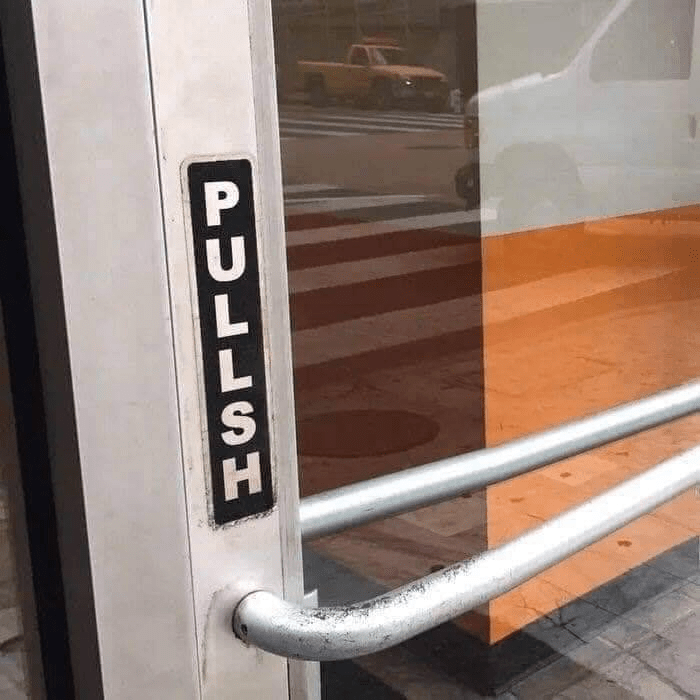
But that’s for next time. For now, don’t let the door hit you on the way out:

You Can Afford It

Note: This is part one of a three-part series. The second and third parts will be released in the upcoming weeks.

Deciphering the mechanisms behind human perception is one of the great challenges faced in the behavioral sciences. Much like the reasons people enjoy going to the dentist, the way our brain integrates sensory information into a perceptual experience remains largely a mystery. This does not mean, however, that we know nothing; much has been discovered, with much more on the way. Of the perceptual principles we understand so far, I’ll focus on just one: Affordances.

According to the psychologists Eleanor and James Gibson, all human sensation prepares us not just to experience the world, but to act in it. When viewing an object we use a variety of cues to understand what we’re looking at, including shape, color, size, orientation, and context. In addition to what the object looks like, however, we perceive an object’s identity based on how we can interact with it. When we see a cup, for example, we know that we can grab, lift, throw, fill, or drink from it. Each potential interaction is an affordance.

We use affordances constantly: we see a chair and we know we can sit in it; we see a door and we know we can open or close it; we see a book and we know we can open it, turn the pages, and read it. We don’t have to think about it. We’ve been interacting (I assume) with chairs and doors and books so long our affordances are automatic. Even my speaking of “knowing” belies the nature of affordances. They are not conscious designations; instead, they almost always occur without our awareness.

Child’s Play

I say almost always because there are important instances when affordances are decidedly not autonomic. Children, for example, are always encountering objects for the first time; their affordances are conscious and often comical. I distinctly remember my first encounter with one of these as a kid and my complete bewilderment as to what it was for. Only after I questioned my mom did I assign it the “correct” affordances and stop pretending it was a space ship (just kidding I still pretend they’re spaceships when I come across them). The same is true for adults learning a new skill or hobby, in which case affordances become not only conscious, but often self-conscious.

These instances give insight not only into how affordances work, but also how we can use them more deliberately to our advantage.

Creativity

As mentioned previously, children often have difficulty assigning the “correct” affordances to objects they see. While this can be quite comical (or frustrating, depending on the situation) it is precisely this fluidity of affordances that gives children one of their great strengths: Creativity.

Affordances may not be the first thing that comes to mind when thinking of creativity, but they are at its core. They deal in possibilities, what could be rather than what is, and therefore provide the basis for imaginative thinking.

Again, children are excellent at this: a stick in the woods isn’t just a stick, it’s a sword or a lightsaber. A cardboard box isn’t just a box, it’s a castle or a car or a spaceship. LEGOs, Play-Doh, and building blocks all operate under the premise that they can be anything, if only you have the imagination to make it. Children are constantly at play, so they constantly see things to play with.

Adults tend to struggle more with this. On one hand, we’ve been interacting with things so long we fail to see them for anything more than how they’re “supposed” to be used. On the other, we’ve had it beaten into us (sometimes literally) that mature people don’t play, at least not in the ways children do. There’s a stigma against adults who still play with LEGOs or enjoy playing cards or like LARPing. As a result, we get out of practice being creative, and we let our affordances fall flat.

This so detrimental because (among other things) affordances play an essential role in some of the most important aspects of life

First, let’s look at the process of invention. Invention and affordances are deeply intertwined, especially when the invention consists of adopting existing technologies for other uses. Take, for example, bubble wrap: initially created to be a textured wallpaper, it quickly became the primary method for protecting products in transit (as well as a great stress reliever). Frisbees came from the empty pie containers of the Frisbie Pie Company. Play-Doh itself was originally used as a wallpaper cleaner until someone realized it was great for modelling and molding. The world is full of products with unintended uses, all because people afforded them. The history of invention is, in part, a history of affordances.

Invention isn’t alone in this: all of art is an exercise in affordances. Some of my favorite pieces (like this) consists of artists seeing past what is and seeing what can be. They ignore the obvious and create something beautiful and fun out of what normally would seem mundane or ordinary. Similarly, one of my favorite taking googly eyes and putting them on things. At the extremes of art we find the blank canvas, the block of marble, and the ball of clay, all of which come with infinite affordances: whatever we can imagine. Like Michelangelo said, “I saw the angel in the marble and carved until I set him free.”

If you want to be more creative, question your affordances.

The 2021 Book Awards

Nothing makes time fly quite like the realization that 2020 hasn’t lasted an extra year and it’s already 2022. Much like 2020, 2021 has been full of events that happened several years ago, like the storming of the U.S. capitol, the inauguration of Joe Biden as president, and the 2020 Summer Olympics. With the year already coming to a close, it’s once again time for reflection and meditation and resolution and whatever else people do when the calendar resets. It’s also time for the second annual Book Awards based on the reading I’ve done this year. Once again, it was a fruitful year for reading (and, once again, a fruitful year of wasting my time doing things other than reading). Let’s get to it.

Awards

Best Fiction: The Count of Monte Cristo by Alexandre Dumas (Narrated by John Lee)
Wow, this book is truly incredible. And long. Which is why I didn’t even read it, I listened to it. I have a constant internal struggle about the validity of me listening to a book and then claiming I read it (and I question how much I get out of it), but in this case, because it was the only way I would have consumed Monte Cristo, (I previously tried to read it) I’m counting it. This book is awesome. The characters are all fabulous, and the way Dumas weaved and wove each of their lives together and introduced new characters whose lives also weaved and wove together was dynamic and exciting. The plot was also thrilling, and seeing the way the Count weaved and wove his own revenge into the lives and actions of the others was enthralling. 10/10

Runner-up: Ender’s Game by Orson Scott Card
This book also earns the award of most recommended, since I think anyone who knew I hadn’t read it told me I needed to (which is partly the reason it took me so long to read. That and I have an unexplainable aversion to science-fiction book covers from the 80s and 90s). Annoyingly, when I started reading this one I couldn’t stop because it was so good. Seeing Ender’s growth and development was really fun, because I always love seeing a character who is masterful at what they do, but it was also such a tragic story. No spoilers of course (even though it seems like I’m the last person to jump on this bandwagon), but the ending was shocking, and if the chance for redemption wasn’t offered I wouldn’t have liked it (which maybe was part of the point). Overall a stellar story with lots of emotion and tragedy and also hope and love. 10/10

Best Fantasy: The Lord of the Rings trilogy by J.R.R. Tolkien
I mean honestly, when I read Lord of the Rings it’s going to come out on top in at least one category. These books are some of my favorite of all time and this certainly isn’t going to be the last time I read them. The world-building is phenomenal and the characters are all so good (even Tom Bombadil, you haters). I get lost in the story and the adventure and just have a blast. Beyond just the story though, I love the themes of courage and brotherly love and perseverance and the characters who embody those values. Plus the moral complexity of Gollum/Smeagol, Boromir, Tom, and others makes it more than just a basic good guys beat the bad guys story (even though that does happen in the end). 11/10

Runner-up: The Ranger’s Apprentice series, by John Flanagan
Though not as epic, grand, or complex as Lord of the Rings, These books (11 that I read out of 12) are also among my favorites (and are probably one of the principle reasons I received a bow and arrows for a birthday growing up). The characters, though sometimes a bit stereotypical, are a lot of fun to watch grow and develop and interact with each other. I also love seeing the nearly mythic proficiency they have in their respective skills (again, I love a good character who is masterful at what they do). Overall a fun, generally light-hearted romp through the England, mainland Europe, Africa, and Asia of an alternate universe.
Objectively: 8.5/10 Personally: 10/10

Most Emotional: When Breath Becomes Air by Paul Kalanithi
This book often shows up in must-read lists, and because it was written by a neurosurgeon I decided I should give it a read. Which is good because this book was excellent, and the only one this year to make me cry. Paul did such a good job writing about his experiences and the way his perspective changed as he went from a top neurosurgeon to a suffering cancer patient trying to handle sickness, marriage, family, and work. The decision to have a child even though he was dying was really touching, and the passage he wrote to his newborn daughter just before his death really hit me. 9/10

Most Deceptive Title (Good): I Don’t Believe in Atheists by Chris Hedges
Given the title I was a bit concerned this was just going to be a fiery attack against all atheists everywhere and why they’re garbage. Fortunately, it was a much more balanced view about why both religious and atheist fundamentalists are often dangerous to society, and the flaws in both sides. It did have a bit more to say about atheists, but it wasn’t a condemnation to the lowest pits of hell for heresy and blasphemy. It wasn’t even an argument for or against the existence of a god, just a look at the dangers of fundamentalism. It was quite refreshing, though sometimes hard to follow. 8/10

Most Deceptive Title (Bad): God is a Question not an Answer by William Irwin
Given the title (and the synopsis on the inside cover) I expected this to be a solidly agnostic view of the question of a god that would have insights as to the positives and negatives of both atheism and theism. In reality, it was more of an atheist work thinly veiled in the guise of agnosticism. It was still a fine (as in, “ok”. Not like, “dang you fine!”) book with some good insights, but it was not what I expected. 6/10

Most Difficult to Understand: There is a God by Anthony Flew
I’m sure this is a good book, but because it was so heavy on the minutiae theological philosophy it was often very difficult to understand and not at all groundbreaking for me. It was interesting to see some of the reasons Anthony went from a devout atheist to a convinced theist, but because it was so dense and heavy on the jargon I got very little out of it. 5/10

Runner-up: Gulliver’s Travels by Jonathan Swift
I picked this one up because I love me a good satire and it’s also one of the oft-referenced classics everyone knows about but hasn’t read. In general I enjoyed this one, but because it was written back in the early 1700s, much of the satire was lost on me. The version I read was annotated by Isaac Asimov, so a lot of it was explained, but the hassle of switching between the actual novel and the explanations of the jokes really took its toll. It was really interesting seeing a conservative satire though; most satire I’m exposed to these days is from the liberal viewpoint, but seeing Swift hate on the advancement of science was quite entertaining on more than one level. 7/10

Book I expected to be Easier to Understand: Thing Explainer by Randall Monroe
Thing Explainer is a book explaining different machines or phenomena using only the 1,000 most common words in English, which seems like it might make it easier to understand (he can’t throw around fancy words like “quantum entanglement” or “chiasmal decussation” or “nine”), but when you try to explain rocket science without using the word “rocket” things can be a bit confusing. It becomes a puzzle trying to figure out that “sky bag air” probably means “balloon air” which probably refers to helium, which can either be really fun or really confusing (usually both). I had a fun time reading it and looking at the trademark comics that accompanied Monroe’s descriptions. 9/10

Best Historical Work: The History of the Ancient World by Susan Wise Bauer
With a great narrative voice (Bauer is hilarious and gives a great female perspective), plenty of explanatory footnotes, and more than enough maps to give visuals of unfamiliar land, this is easily one of the most engaging history books I’ve read (especially considering it was almost 800 pages long). It has the credit of really driving home for me (and this is something that will really stick with me) the idea that myth isn’t diametrically opposed to fact. Instead, much of myth/legend has roots in historical events and there’s much we can glean from it. The book’s only problem is that, while starting off strong as a history of a significant part of the world, it wraps up as essentially just a history of Rome (which normally would not bother me at all, but in this case made me feel like I missed out on a lot of Chinese, Indian, and southeast Asian history). 9/10

Runner-up: Istanbul: City of Majesty at the Crossroads of the World by Thomas F. Madden
Istanbul (not Constantinople) is one of those historical places everyone knows about without actually knowing much about. Istanbul (not Constantinople) has been, like it says in the title, at the crossroads of the old world since its conception and has played a significant role in world history for nearly as long. It was fascinating learning about such a well-known city, especially since Madden does such a good job of it. 8.5/10

Best Guilt Trip: The Boy Who Harnessed the Wind by William Kamkwamba
This book was a great one, about a man who was trapped in a cave in the Middle East and built his own electric generator out of scraps to power his heart/suit. Oh wait, that’s not right. This is about a boy who grew up in rural Africa (Malawi to be specific) and decided to build his own electric windmill out of scraps to power his house after learning about electric generators in a book. It’s an awesome story, both inspiring on the one hand and kind of embarrassing (for me, not William) on the other. William is an amazing person who has done so much with so little, and his story makes me feel like I’ve done so little with so much. It’s like this scene in Iron Man. But anyway, the book was quite good and I’m glad I read it. 9/10

Favorite New Author: Sir Arthur Conan Doyle
It’s a shame none of his books earned any other awards here; my first foray into the literary world of Sherlock Holmes was excellent and I can see why he’s been such a popular figure for so long. A Study in Scarlet was good, though the second half was rather strange and for a while I wondered if I was actually reading the right book. The Sign of the Four was even better (and the second half wasn’t a weird fever dream), and then to top it all off I read The Hound of the Baskervilles which was just fabulous; I loved it. I haven’t read all of the Sherlock Holmes stories yet, but they’re definitely on the list for next year.
8.5/10

Runner-up: Steven Pressfield
This is based mostly on my reading of The War of Art and Do the Work, though I did read The Afghan Campaign (and while very interesting and historical and well-written, wasn’t necessarily my cup of tea). The War of Art was really good though, and I enjoyed it a lot (shoutout to Joseph Douglas for recommending it to me). Do the Work was a bit of a rehash of the War of Art, which means it was still good just not strictly necessary. 8/10

The Movie was Actually Better: Stardust by Neil Gaiman
This isn’t to say the book wasn’t good, because it certainly was and it does of course deserve recognition for inspiring the movie. It’s built on a solid premise and has lots of clever, fun moments, but when it comes down to it, Stardust feels a bit unpolished. I imagine that if Gaiman were to revisit it, Stardust would be much more impressive, but as it stands it’s a fun story that I would prefer to consume in movie form.
Book: 7/10 Movie: 10/10

Most Eye-opening: Educated by Tara Westover
This book was a real mind-bender. Tara does an outstanding job of relating her childhood experiences, which were horrifying. It’s so easy to subconsciously adopt the idea that your own childhood and upbringing are the universal normal, but reading Educated really shook that idea at its core; Tara’s upbringing was so far removed from my own (and hopefully yours) that it was hard to believe sometimes. This, of course, made the book even more engaging, and I ended up really enjoying it. Tara really is a great writer. 9/10

Runner-up: Invisible Women by Caroline Criado-Perez
Shout out to my wife Sadie for recommending this one to me. This book, though not as overtly shocking as Educated, was still full of interesting and unexpected statistics/stories about ways the world has been designed around the male experience and how it subtly (and sometimes not so subtly) works against women. Overall it was an eye-opening read and it has really stuck with me. 8/10

Least Favorite: Terminal Man by Michael Crichton
This one pains me. Michael Crichton is one of my favorite authors, so I was of course excited to read another of his books. Imagine my disappointment when Terminal Man was a long science-y book about nothing (ok not nothing, but that’s what I remember from it). It also had one of the worst climaxes of any book I’ve read. Really just a huge disappointment. 1/10

Books I couldn’t Finish: Musicophilia by Oliver Sacks
This one also pains me, since Oliver Sacks is such a good writer and I really enjoyed The Man Who Mistook His Wife for a Hat. Musicophilia has a really fascinating premise (really one of my favorite topics: the neuroscience of music), but it was a bit long and rather boring. It was far less about individual case studies and what they reveal and more a conglomeration of stories that supported the same hypothesis over and over and over again. It was still interesting, but far too slow and unwieldy for me. Perhaps I’ll try again later and I’ll be more in the mood for it. ??/10

The Success Principles by Jack Canfield
This one doesn’t pain me. I’m sure it’s a good book with a lot of good stuff, but it, too, was far too slow and just not my cup of tea. Perhaps it also just seemed a bit too preachy and “get-rich-quick”-y. Again, maybe I’ll be more interested if I try it again later, but I’m not really inclined to. ??/10

Honorable Mentions:
Just Like That by Gary Schmidt
Shout out to Annemerie Jensen for recommending this one to me. This is the third book in the world, along with Wednesday Wars and Okay for Now (both of which I highly recommend). This one, the longest of the three, was just as emotional and fun and I loved it.
9.5/10

Mere Christianity by C.S. Lewis
This one could have won the “It’s about time” award since it’s taken me so long to read even though I’ve claimed to love C.S. Lewis’s writing for so long. It’s not my favorite C.S. Lewis book, but I did quite enjoy it; It’s a thorough exposition on the tenets of Christianity and it’s importance as a religion. I’ll have to re-read it sometime soon, as there was so much in it that I can’t remember it all, but in the meantime I’ll remember it as a great read. 8.5/10

The Slight Edge by Jeff Olson
Shoutout to McKell Ruiz for recommending this to me. This was one of the better self-improvement/business/leadership/whatever-you-call-it genre of books I’ve read. It’s based on the idea of small, incremental improvements in daily life rather than large, life-changing habits. I remember it being very inspiring and very good while I was reading it, and being excited about the ideas it has, but now I don’t remember much about it at all. So take that as you will. I would still recommend it, but I’d have to re-read it to really remember what I’m recommending. 8/10


And there you have it: a taste of the reading I’ve done this year and my impressions of it. If you have any comments or criticisms or anything at all about the reading I’ve done (and my ratings and remarks) I’d be more than happy to hear it. And maybe fight you about it, depending on what you say.

For a complete list of my reading this year see here.